Harnessing AI to Transform Fleet Risk Data into Actionable Insight at Aon
Executive Summary
Aon Fleet Risk Intelligence — a B2B platform delivering fleet risk insights for brokers, insurers, and large fleet operators.
Role
UX Lead — UX strategy, research, design execution, and optimisation.
Goal
Improve usability, accessibility, and scalability while enabling faster, more confident risk decisions.
Business Problem
The platform surfaced large volumes of risk data, but users struggled to interpret insights quickly — particularly as fleet size increased and the underlying risk model evolved.
This created four strategic risks:
Slower decision-making in safety-critical workflows
Reduced adoption among larger enterprise fleets
Erosion of trust during the transition to a unified AI risk model
Increased support and training overhead
Context
Product
Aon Fleet Risk Intelligence — a B2B analytics platform serving insurers, brokers, and large fleet operators.
Role
UX Lead — accountable for UX strategy, research direction, design execution, and continuous optimisation.
Mandate
Following Aon’s acquisition of HUMN, the platform needed to scale for enterprise clients while maintaining trust, usability, and regulatory clarity in a data-heavy, risk-sensitive environment.
Impact
40% reduction in decision time for fleet managers (5 → 3 minutes per risk assessment), enabling faster, more confident operational decisions
20% uplift in user satisfaction, driven by improved usability, accessibility, and clarity across core workflows
Enterprise-scale readiness achieved through modular, role-based dashboards optimised for large fleets
Increased trust in AI-driven risk models by making scoring logic transparent and explainable
Reduced cognitive load across the platform through progressive disclosure and prioritised insights
Context & Business Stakes
The Scale
Organisation
Aon — a global professional services firm providing risk, insurance, and human capital solutions to enterprise clients worldwide.
Product Environment
Fleet Risk Intelligence operates within a highly regulated, data-intensive ecosystem, supporting insurers, brokers, and large commercial fleets with safety-critical decision-making.— Former Customer
Operating Context
Enterprise B2B platform with complex stakeholder needs
AI-driven risk models influencing operational and insurance outcomes
Strong emphasis on trust, explainability, and compliance
Post-acquisition integration following Aon’s acquisition of HUMN
The Challenge
When I stepped into the role, the platform was delivering valuable data but struggling to support fast, confident decisions at enterprise scale.
Key risks emerged across usability, scalability, and trust:AreaProblemBusiness RiskData InterpretationComplex visualisations slowed insight discoveryDelayed decision-making in safety-critical workflowsScalabilityDashboards optimised for smaller fleetsReduced adoption by large enterprise clientsRisk Model EvolutionShift to a unified AI model lacked clarityErosion of trust in risk scoresCognitive LoadExpanded risk bands increased complexityHigher training and support overheadMobile UsabilityDesktop-first experiencesLimited effectiveness for on-the-go users
The Opportunity
This moment created a clear strategic opportunity for design leadership:
Enterprise differentiation
Turn complex risk analytics into a clear, decision-grade experience that competitors struggled to deliver.
Trust as a competitive advantage
Use UX to make AI-driven insights transparent and explainable in a regulated environment.
Scalability without complexity
Enable large fleets to manage risk efficiently without increasing cognitive or operational load.
Operational efficiency
Reduce manual analysis and reporting through automation and clearer insight delivery.
Strategic Assessment
Through stakeholder interviews, research synthesis, and competitive analysis, I identified three core constraints limiting platform effectiveness:
Insight latency
Users needed answers quickly, not comprehensive dashboards.
Cognitive overload
Expanding from 3 to 5 risk bands increased complexity without additional explanation.
Opaque intelligence
AI-driven scores were valuable, but insufficiently explained to support trust and action
Design Strategy
I reframed the UX around decision quality and speed, not data volume.
Strategic Principles
• Insight first, detail on demand
• Explainable AI as a UX responsibility
• Role-based experiences for enterprise scale
•Accessibility and clarity as risk-mitigation tools
Execution & Leadership
I led cross-functional design sprints with product, data science, and engineering to align around shared outcomes.
Key initiatives included:
Simplifying visualisations to highlight decision-critical signals
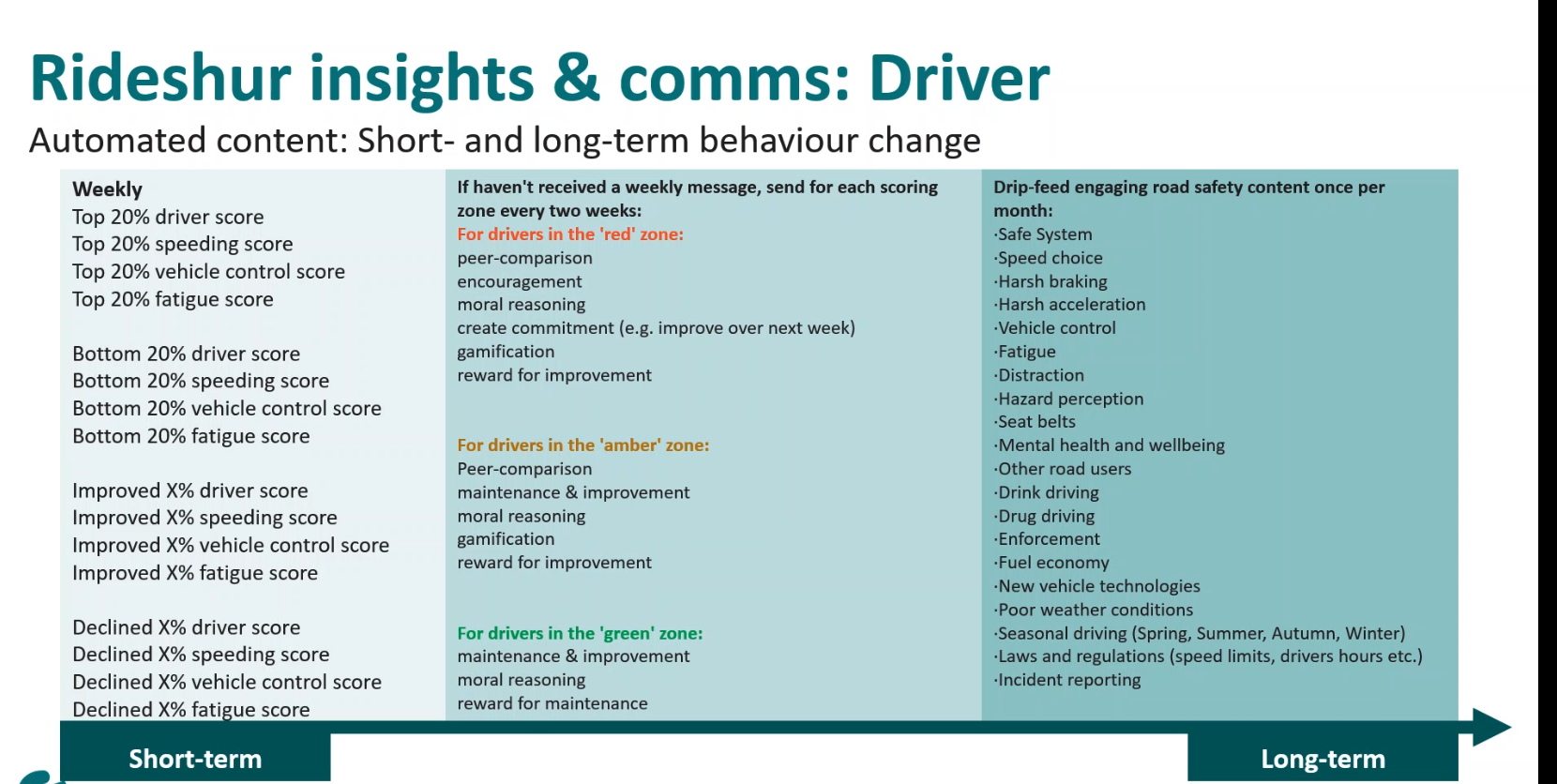
Introducing modular, role-based dashboards for managers and drivers
Implementing progressive disclosure to manage data density
Designing AI transparency patterns explaining risk scores and predictions
Automating reports and notifications to reduce manual analysis
Optimising mobile workflows for real-world fleet usage
All solutions were delivered within Aon’s global design system, with new components introduced only where enterprise needs required it.
Measurement & Validation
Benchmarking Pre-Improvement Metrics
Leading metrics - DAU, WAU, Reports opened by fleet managers and drivers,
Time to assess risk per Driver/fleet ( minutes taken to interpret dashboard insights).
User-reported time estimates from fleet managers (via surveys and from customer success managers).
Number of steps/clicks required to complete a risk assessment.
Lagging metrics - improvement Fleet/ Driver score
What this means in practice
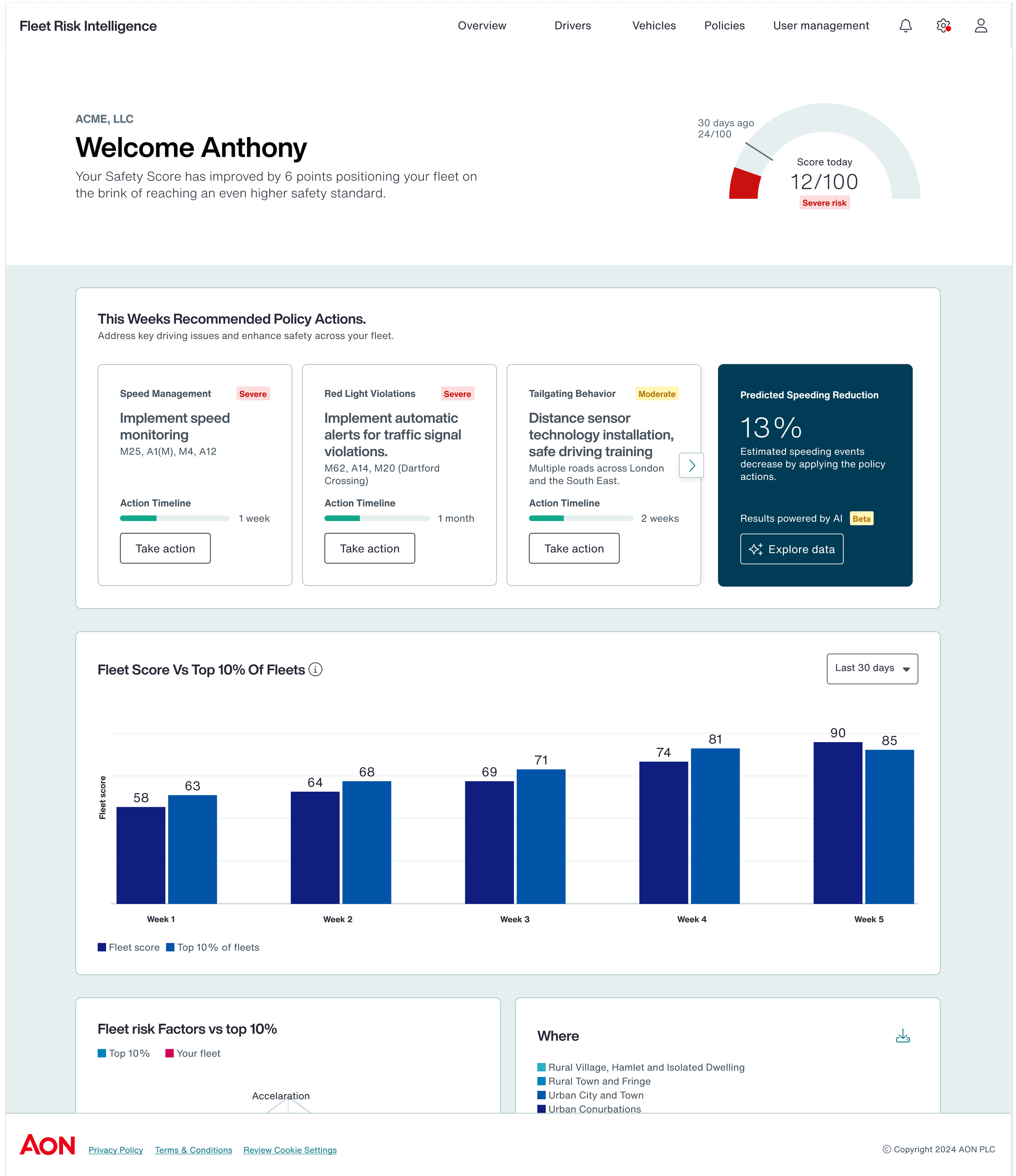
Fleet managers used to take 5 minutes to assess risk, they now take only 3 minutes, reducing cognitive load and decision-making time.
The UX improvements (e.g., better visualizations, automated insights, progressive disclosure) contributed to this faster analysis.
Validated via usability tests, analytics (session duration, click reduction), or user feedback.
The platform shifted from a data-heavy reporting tool to a decision-support system designed for enterprise scale.
-
![]()
Outcome
The platform shifted from a data-heavy reporting tool to a decision-support system designed for enterprise scale.
By improving clarity, explainability, and speed, the UX now supports:
Faster operational decisions
Greater confidence in AI-driven insights
Improved adoption across large, complex fleets
This work positioned Fleet Risk Intelligence as a scalable, trusted product within Aon’s broader risk ecosystem.
-
![]()
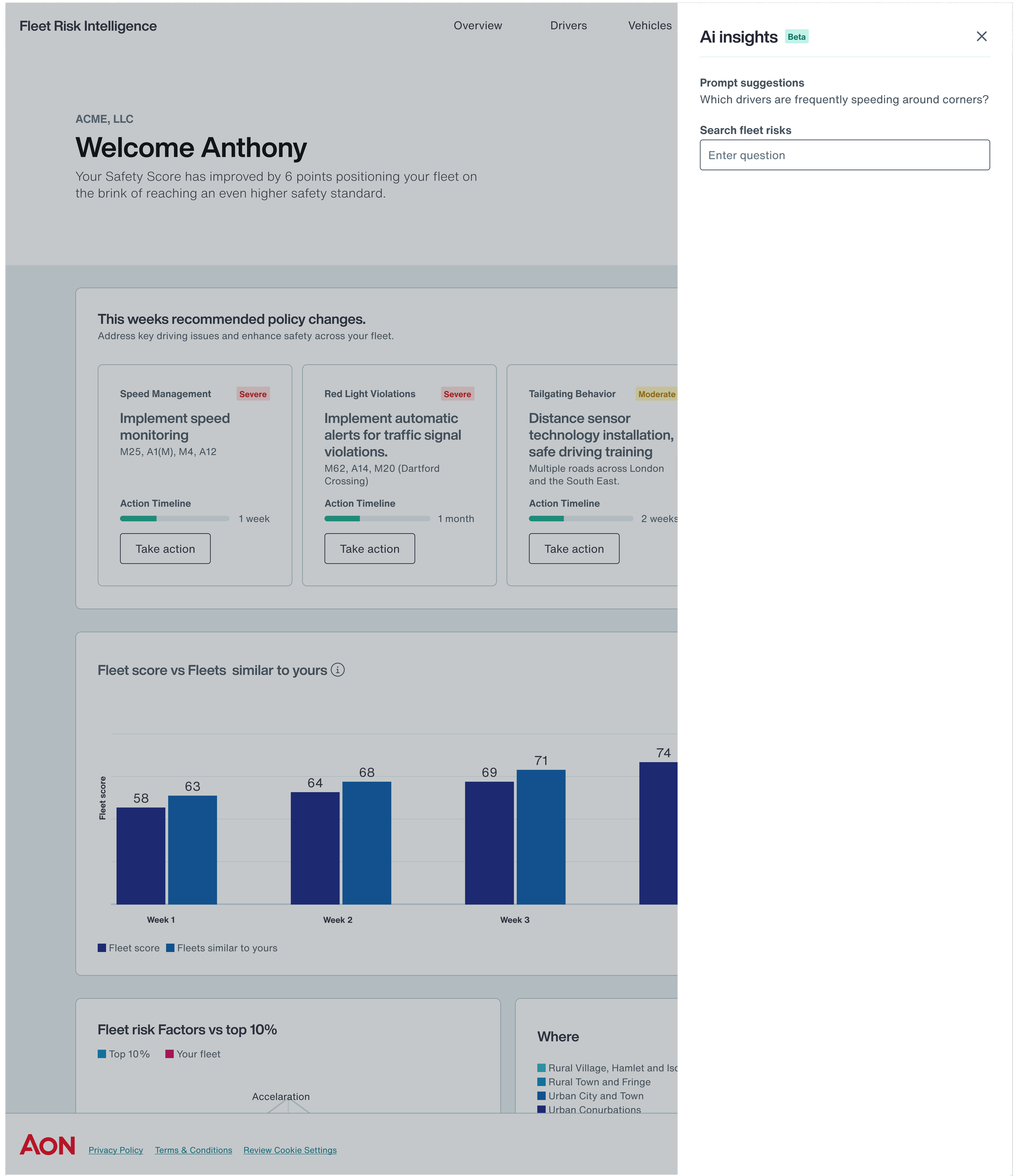
Incorporating ai search.
Key Point: Aon has its own NLM (Natural Language Model), which influenced our approach to data querying.
Result: Users now have greater autonomy to segment and filter data as needed. -
![]()
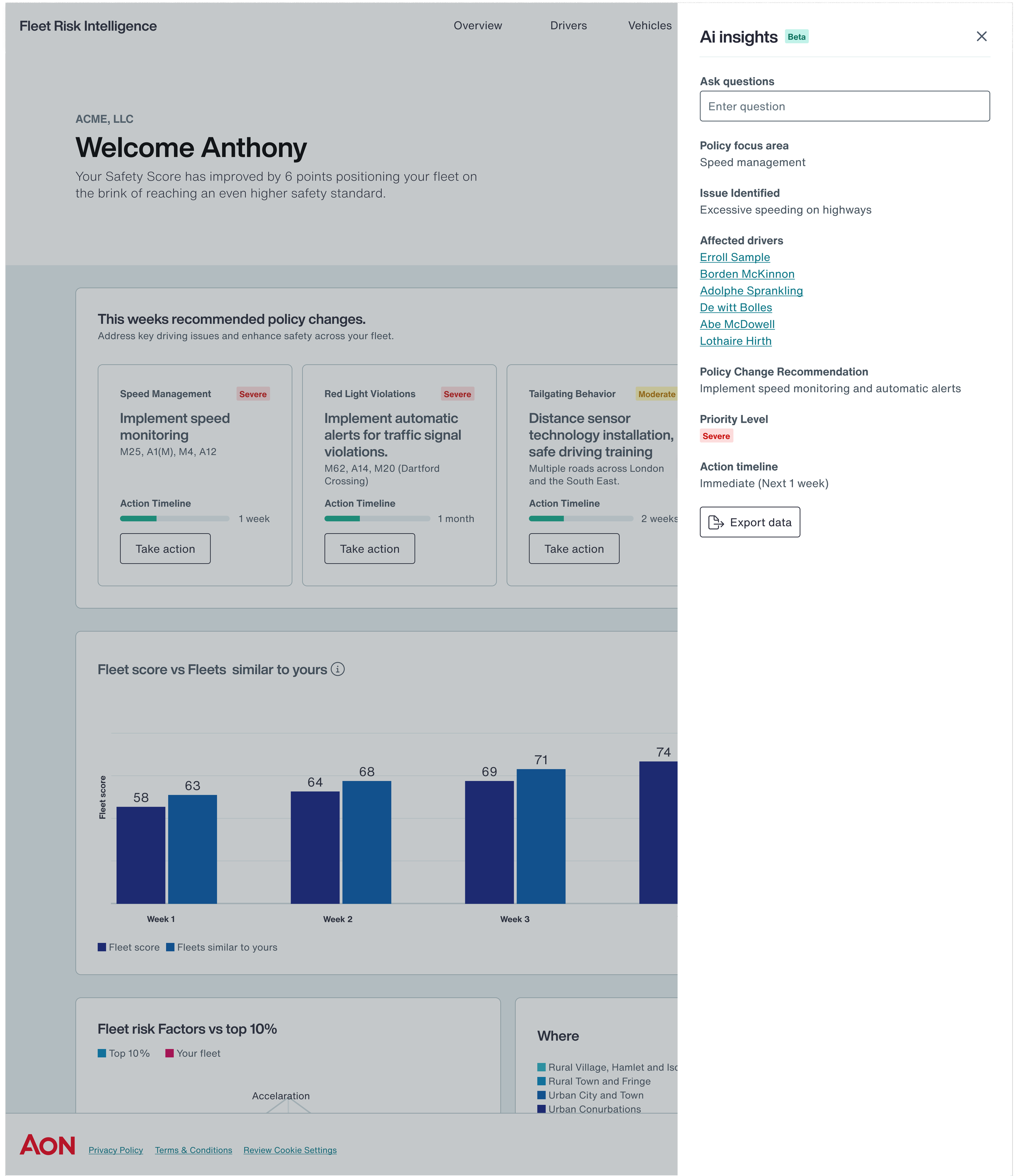
NLM search patterns
Research Focus: Analyzed widely-used Natural Language Models (NLMs) and reviewed UX best practices for NLM search patterns from UX literature.
Design Objective: Aimed to create an intuitive and efficient search experience based on this research.
Consistency: Leveraged Aon’s design library to ensure visual and functional consistency across the platform.
-
![]()
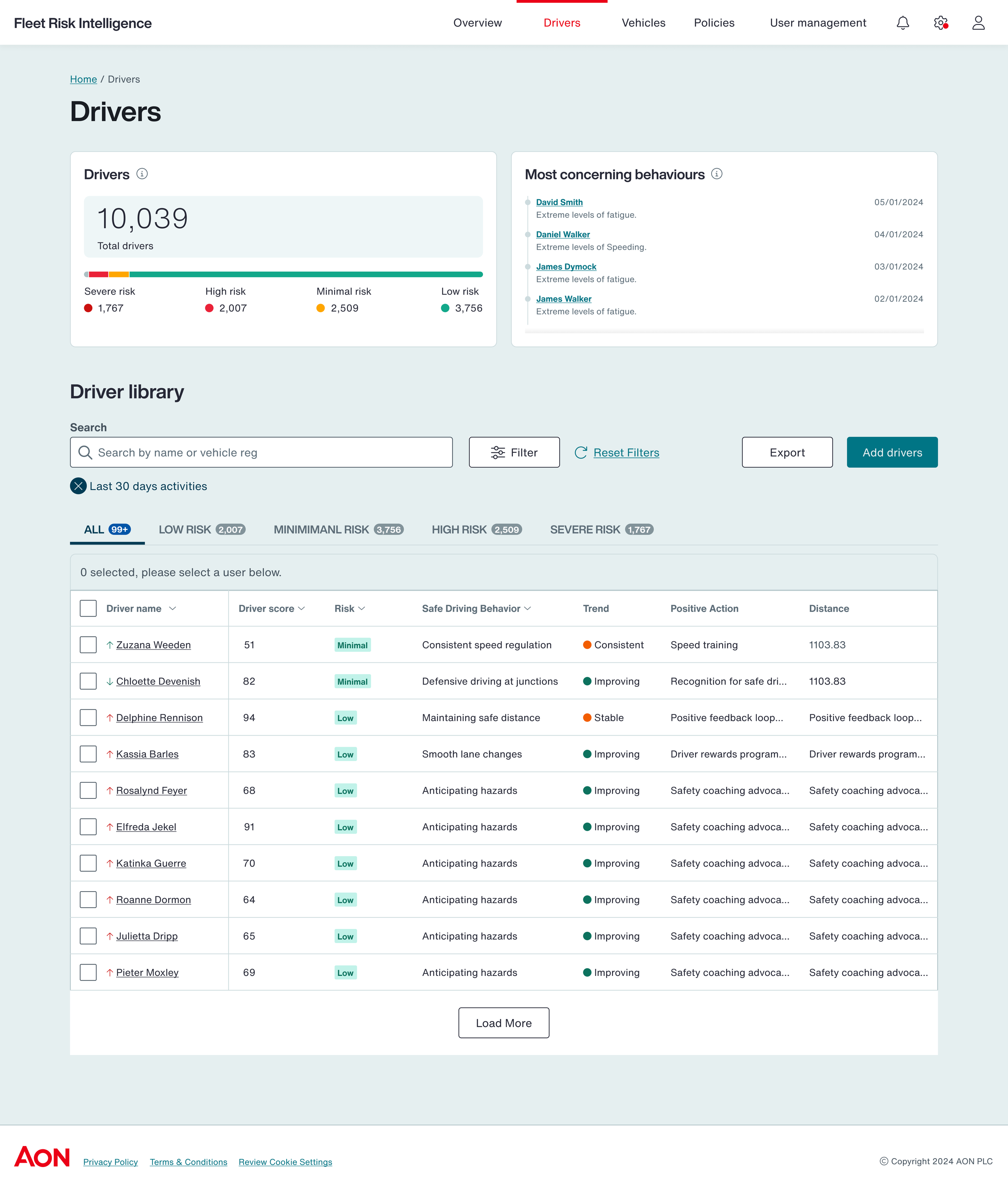
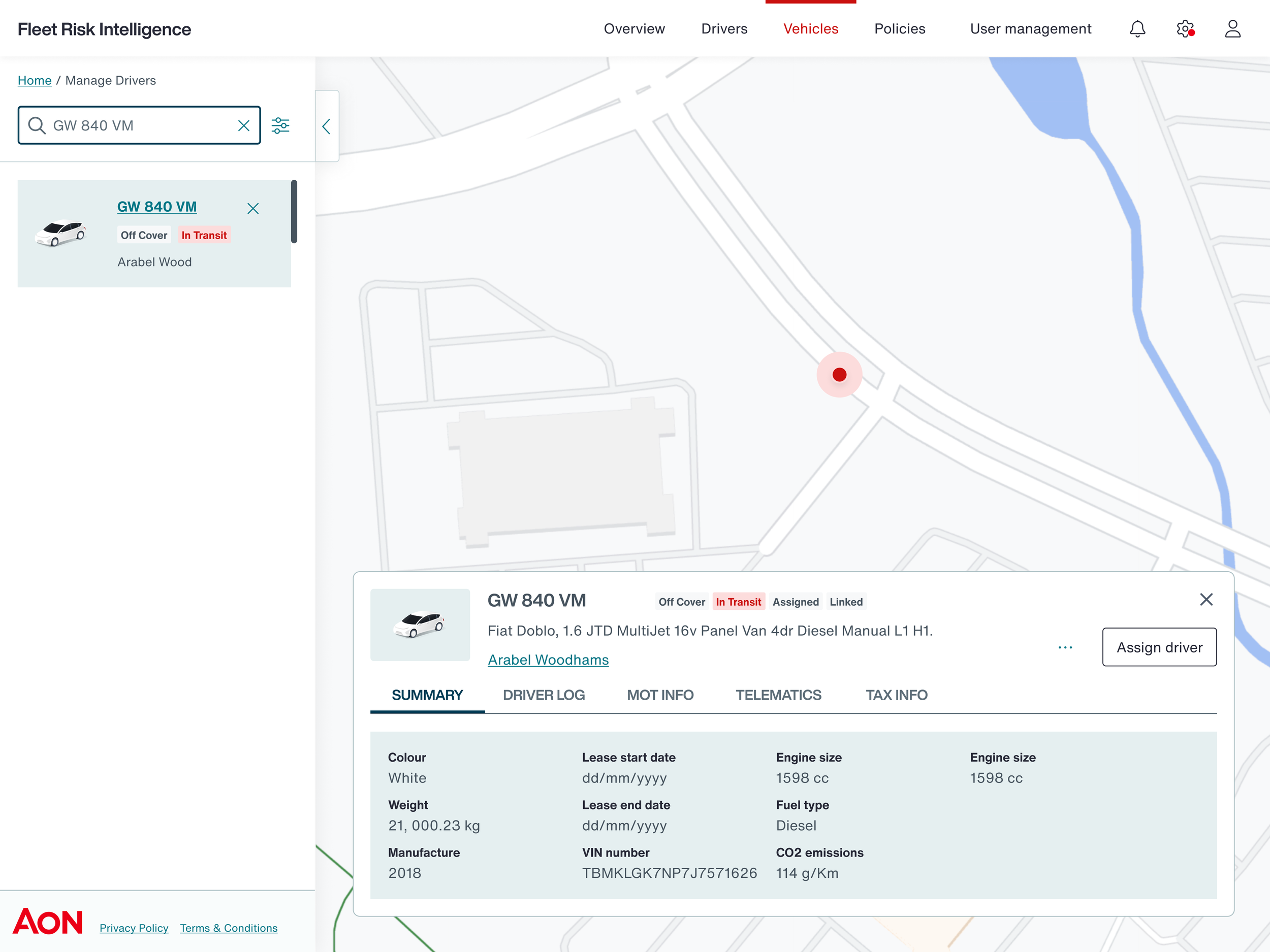
Drivers dashboard
Top priority: Focused on ease of use for users.
Seamless experience: Ensured new local components mirrored the previous iteration’s behavior.
User familiarity: This minimized the learning curve and kept users comfortable.
Key outcome: Successfully integrated updates without disrupting existing workflows.
-
![]()
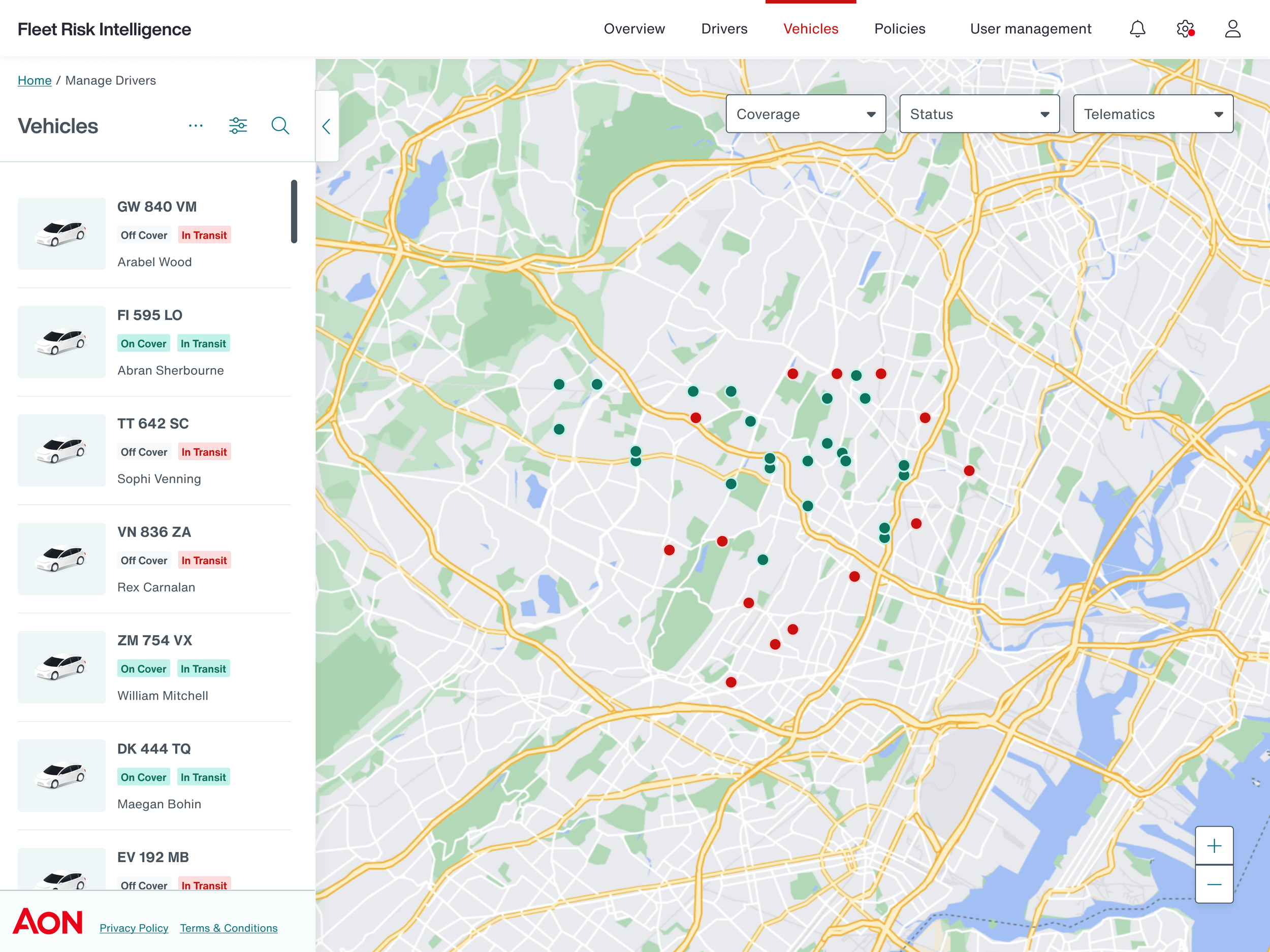
Adapting Mapbox to Aon’s Brand
Aligned Mapbox’s color palette with Aon’s brand identity while ensuring clarity and usability.
Focused on ensuring colors were visually aligned with Aon’s brand but still supported clear data visualization and user-friendly design.
Refined colors to create a harmonious blend of branding and usability.
-
![]()
Approach and Process
Objective: Conducted a color audit to align Mapbox’s default palette with Aon’s brand guidelines.
Compared default vs. brand colors for consistency.
Iteratively adjusted hues, contrast, and saturation to ensure readability and visual distinction.
Achieved a brand-aligned map design.
Ensured usability wasn’t compromised, creating a clear and accessible map experience.
-
![]()
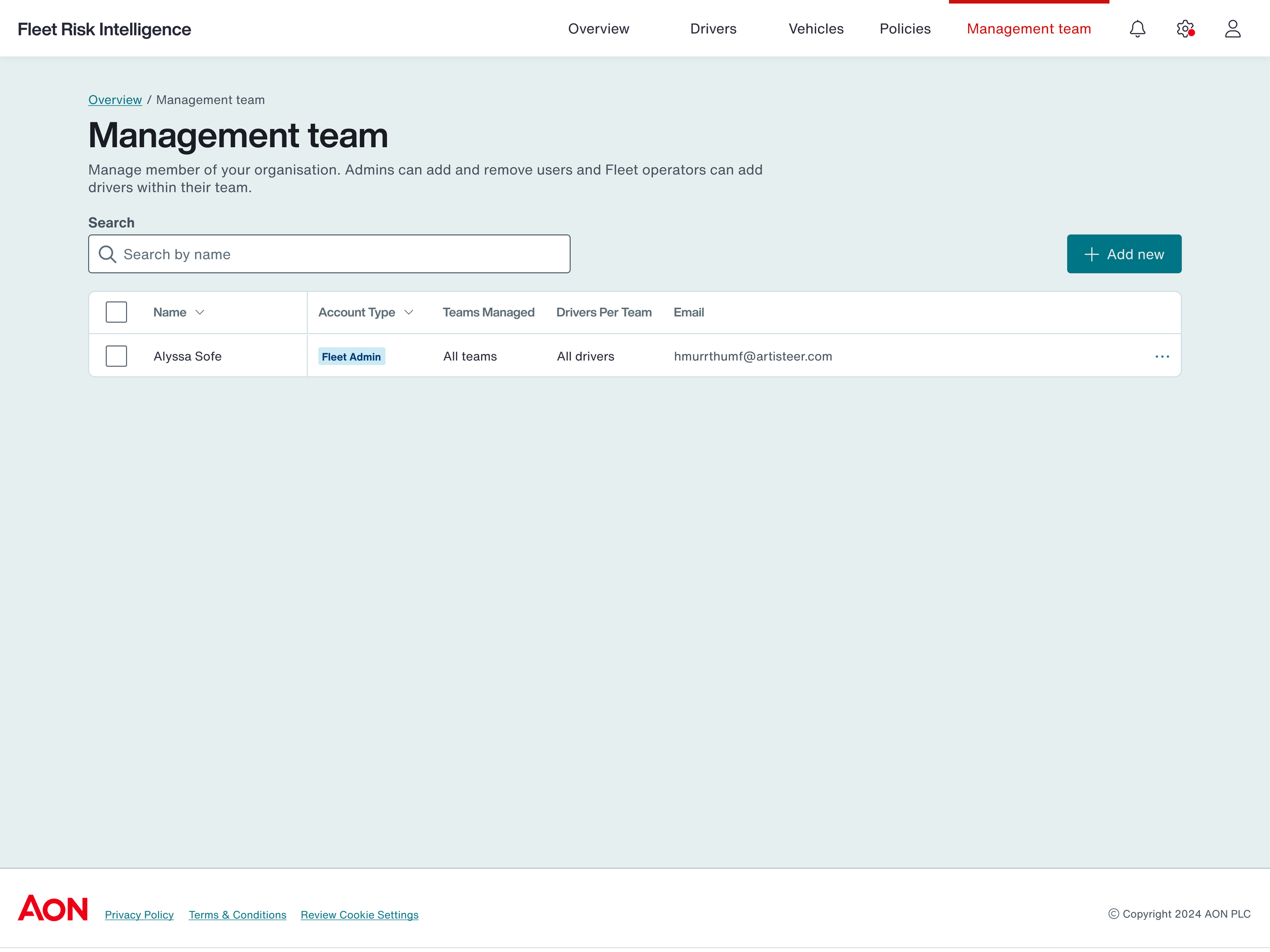
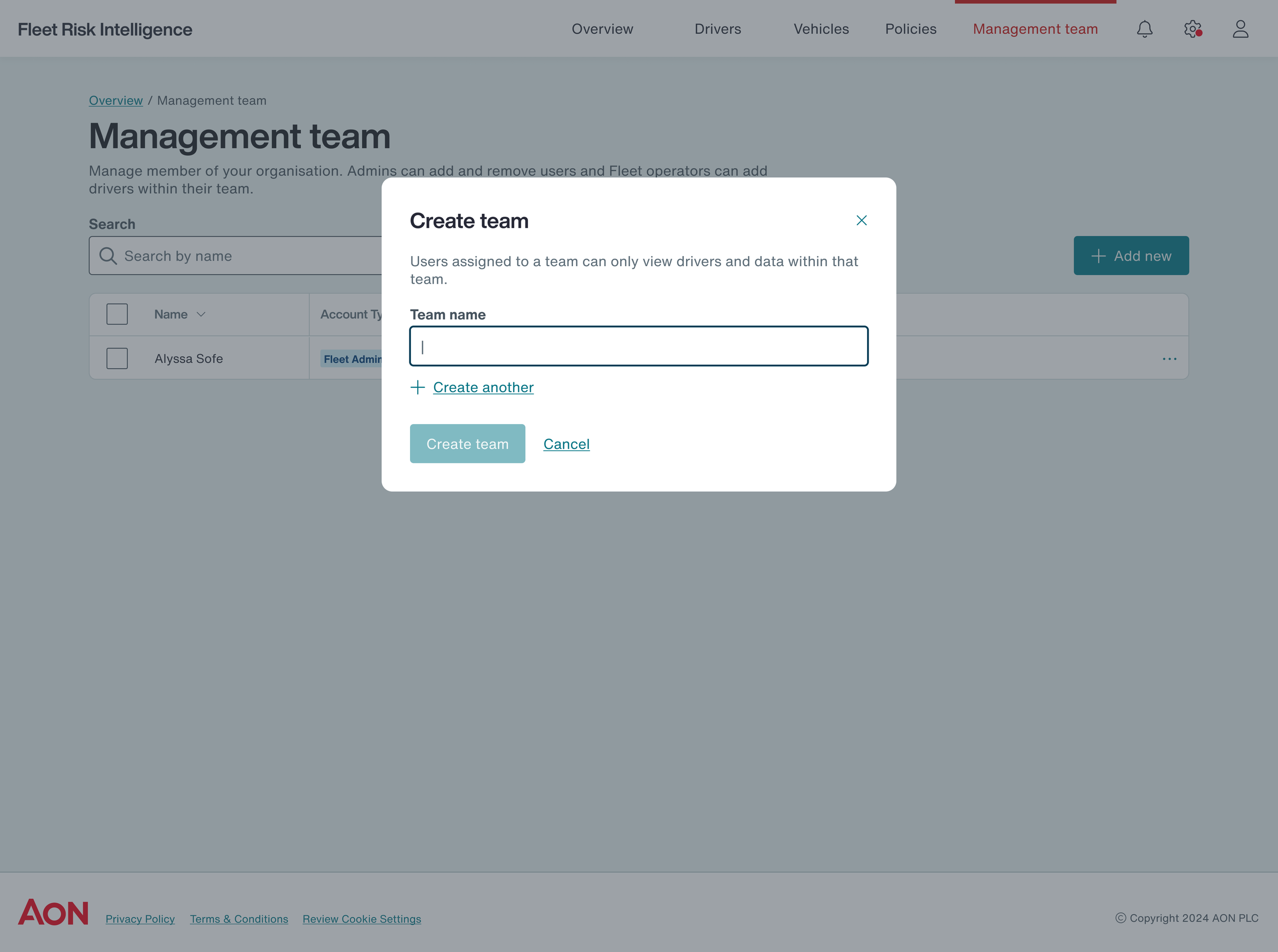
Design debt
Previous iterations led to a backlog of key features to be added.
One of the priority features was User Management for Fleet Managers.
Need: Fleet managers required better control over user roles, access permissions, and team management for more efficient workflows.
Impact: This feature would improve collaboration, streamline administrative tasks, and offer better data security by controlling who accesses what.
-
![]()
Updating Research
Conducted a thorough gap analysis to compare the current state with the new value proposition post-acquisition.
Identified key adjustments needed to align the platform with updated business goals.
Used a structured process for wireframing, prototyping, and iterative testing.
Focused on ensuring designs met both user needs and business objectives.