AI-Powered Customer Context Card — Driving Empathetic VIP Support at Scale
Executive Summary
Customer Context Card — an intelligent, context-aware AI support layer that provides VIP Managers with real-time visibility into churn and friction signals alongside past contact patterns, driving empathetic, high-resolution customer interactions.
Role: UX Lead — UX strategy, research, design execution, and optimisation.
Goal: Deploy a production solution that surfaces live pre-call signals and asynchronous contact patterns to measurably improve customer empathy and CSAT without compromising Average Handling Time (AHT) or increasing escalations.
Business Problem
VIP Managers previously started every interaction blind, lacking visibility into a customer's recent behavioural friction or historical communications:
VIP Manager’s Need: instant, scannable context on a customer’s recent friction (loss streaks or stuck withdrawals etc.) so they could deliver proactive, empathy-first support without breaking live conversational flow or increasing call times.
Customer Need: High-value VIP customers needed continuous, personalized support without having to suffer through 're-explanation fatigue.
Why these needs weren't being met:
Critical customer context was scattered across 6+ disconnected tools, forcing agents into transactional, reactive conversations.
High turnover of VIP managers.
Context
Product
To solve this, I proposed an AI-driven pre-call intelligence tool embedded directly within Betler.
Goal
Rather than making agents search across 6+ tools during a call, my proposal introduced a dual-layer UI architecture: it surfaces scannable, context and behavioural cues.
Mandate
VIP Experience Optimization & Behavioral Context Integration.
Impact
CSAT Lift: VIP Managers using the Context Card achieved higher customer satisfaction scores within the first 30 days.
Measurable Empathy Improvement: Sentiment Delta tracking confirmed calls consistently ended on a significantly more positive tone compared to control groups.
Efficiency Preserved: We eliminated customer re-explanation fatigue while staying strictly within Average Handling Time safety limits and without increasing supervisor escalations.
Context & Business Stakes
The Scale
Target Audience: Live in production for VIP Managers and dedicated support agents handling high-value customer interactions.
Architecture: A two-layer system operating seamlessly in production, kept strictly apart in data, timing, and audience:
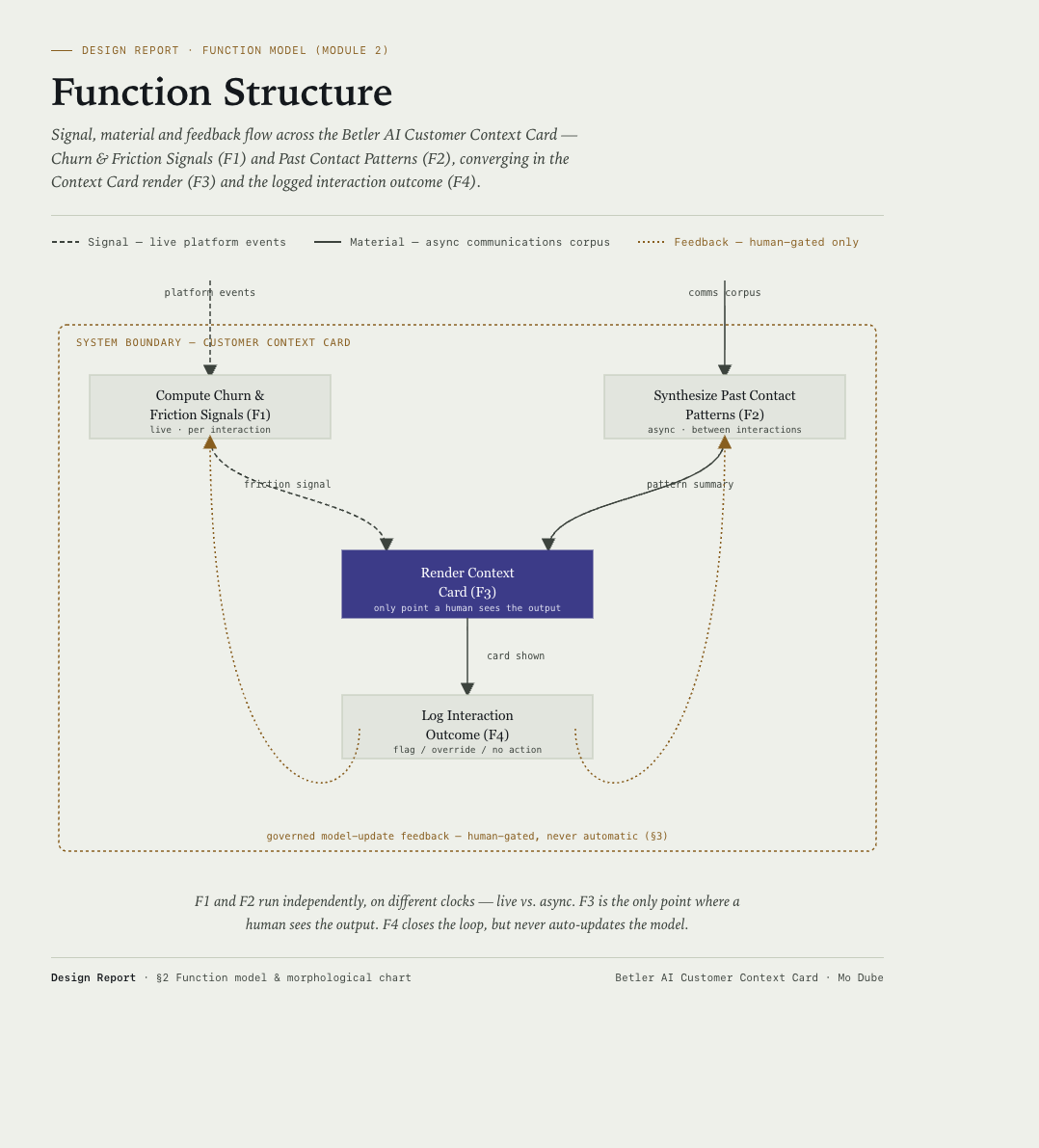
Churn & Friction Signals:Real-time pre-call signals shown to agents (e.g., net losses, failed logins, deposit/withdrawal activity).
Past Contact Patterns (Async): Asynchronous historical interaction reviews (transcripts, emails, chat notes) accessible exclusively to VIP Managers outside of live calls.
Operating Context
Proven A/B Validation: Validated via an agent-level randomized A/B trial (stratified by baseline QA score and tenure) over a 4-week rollout governed by statistical power calculations.
Enforced Guardrails: No numeric scores or deterministic labels are ever shown—only probabilistic language ("suggests," "may") backed by real, named event IDs (e.g., "withdrawal #123").
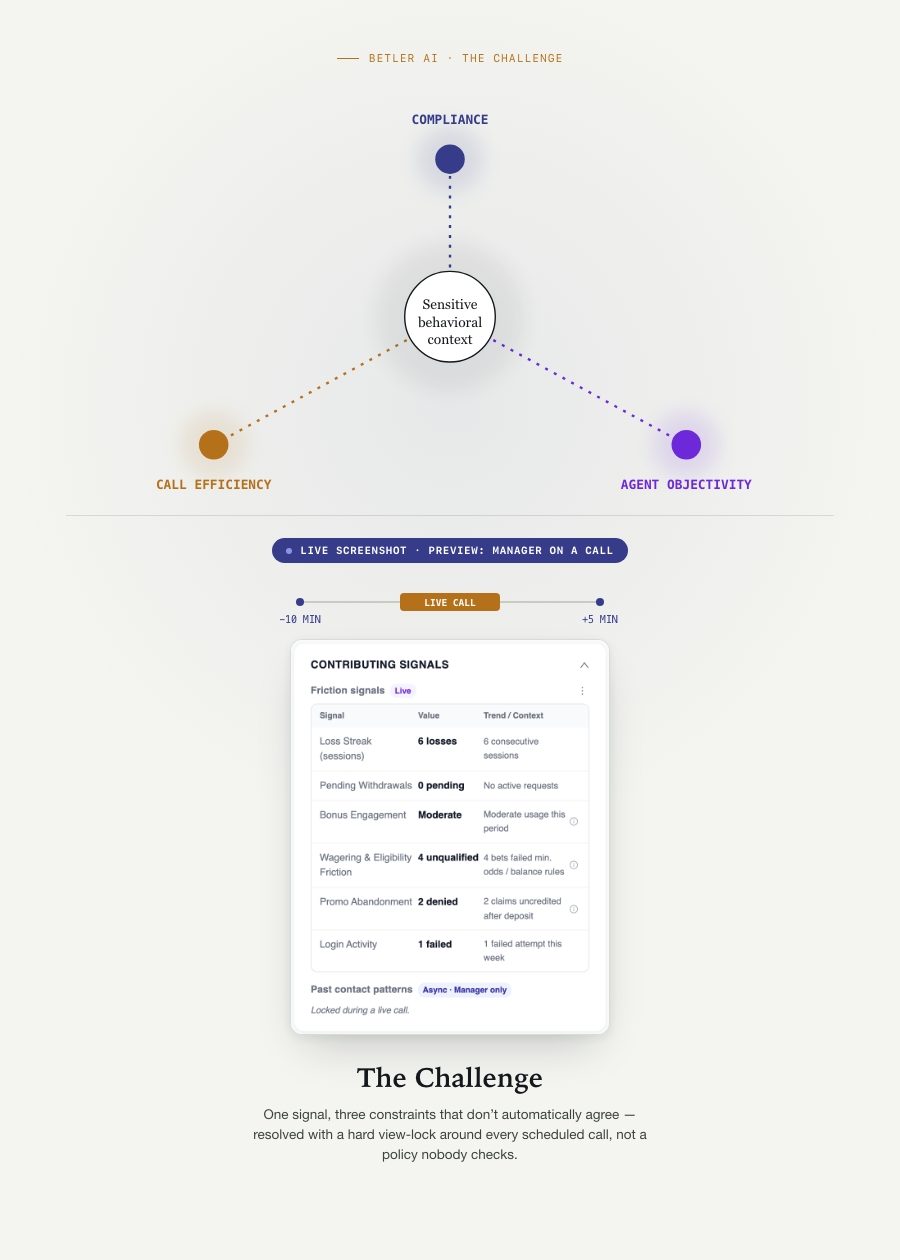
The Challenge
Surfacing sensitive behavioral context without compromising call efficiency, agent objectivity, or compliance.
The system seamlessly routes cases to Responsible Gaming (RG) tooling whenever thresholds are hit, and strictly enforces a view-lock on historical pattern reviews 10 minutes before and 5 minutes after scheduled calls.
The Opportunity, Strategy & Design Strategy
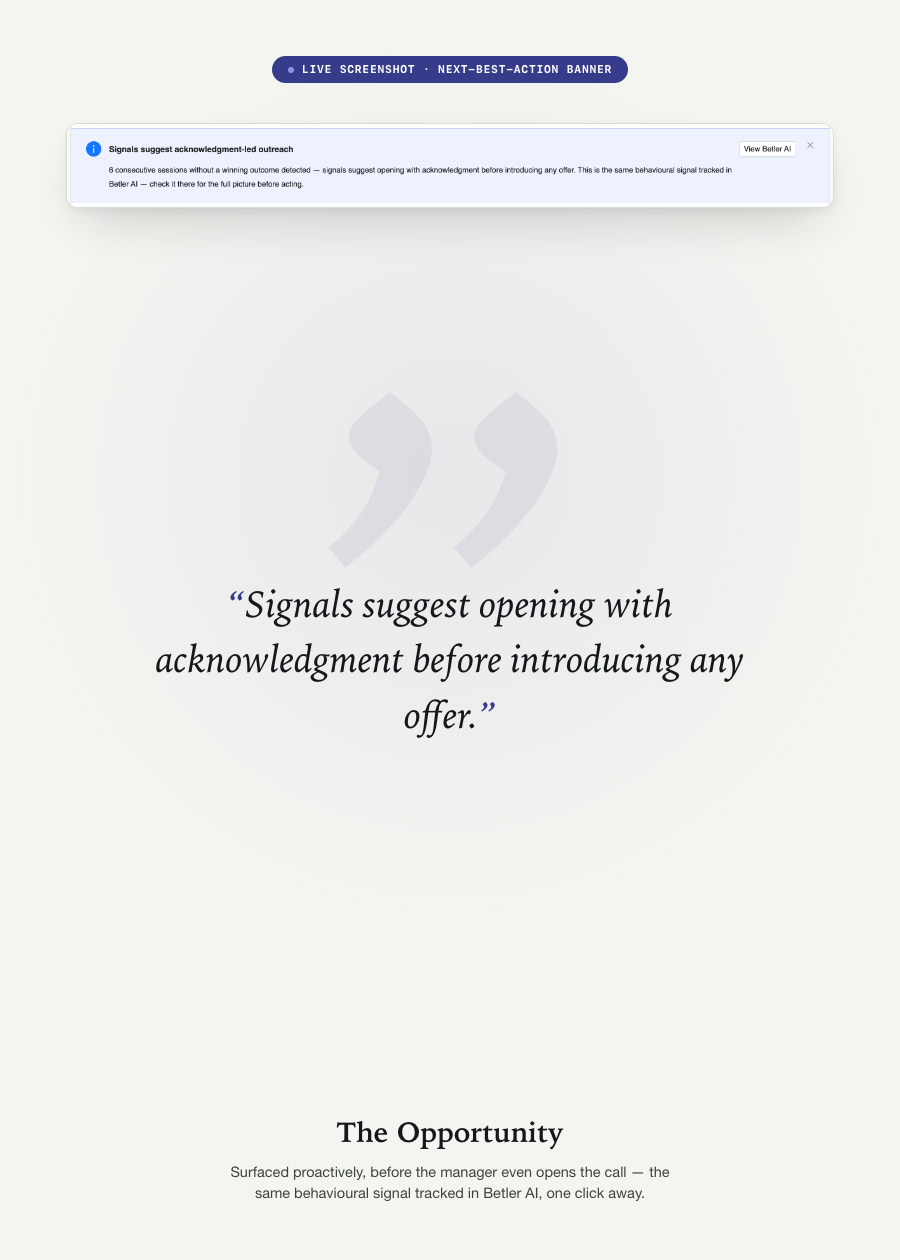
The Opportunity
Transform High-Friction Moments: Convert tense support calls into high-trust customer retention opportunities by serving managers actionable AI context before greeting the caller.
Eliminate Re-Explanation Fatigue: Automatically surface verified past contact themes to relieve customers from repeating their history.
Objective AI Framework: Establish a compliant, objective behavioral model that informs agents without creating cognitive bias or replacing human decision-making.
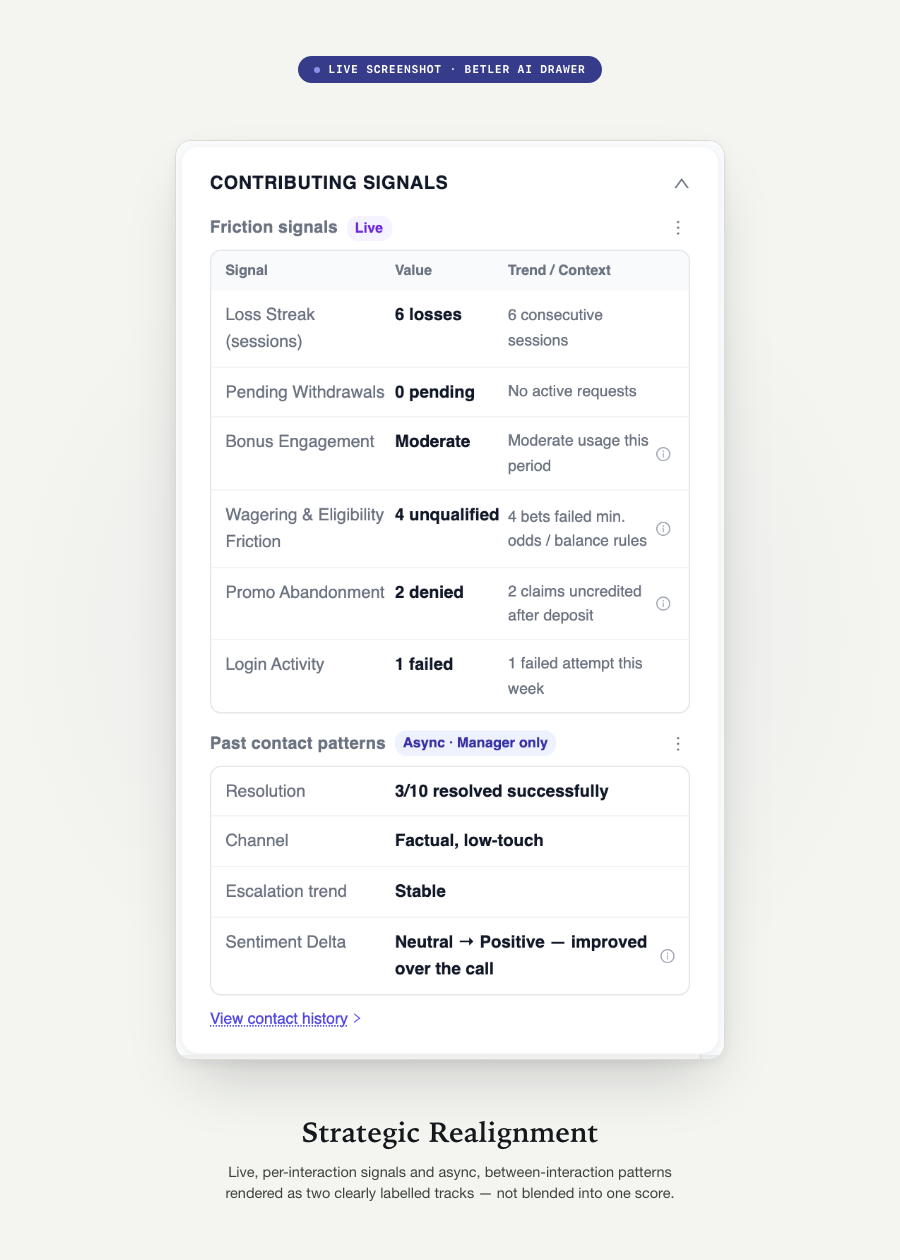
Strategic Realignment
Shift to Proactive Intelligence: Reoriented support tooling from reactive, post-call logging toward proactive, pre-call intelligence.
Decoupled Workflow Architecture: Separated live real-time signals (agent-facing) from asynchronous deep history reviews (manager-facing) to safeguard call velocity and agent focus.
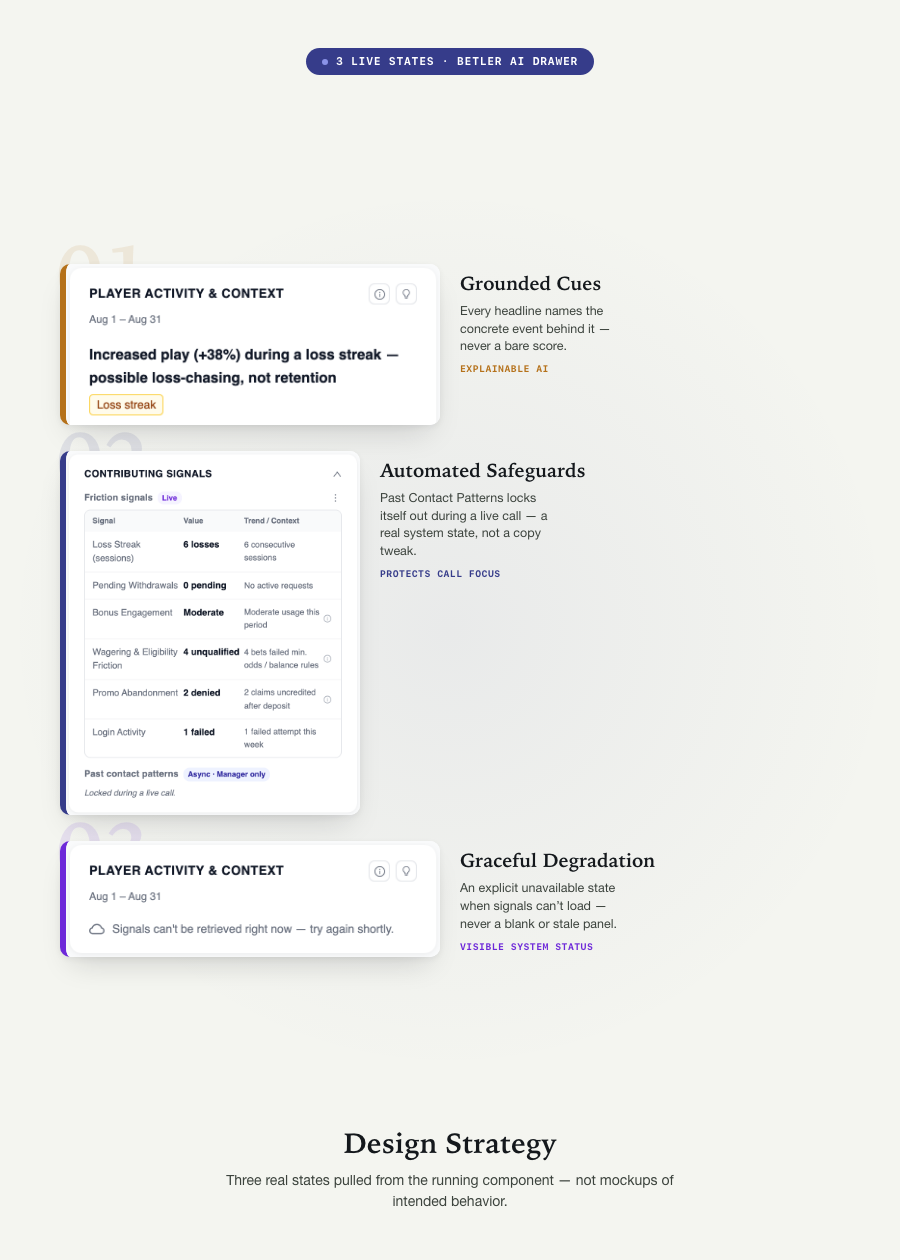
Design Strategy
Grounded Cues (Explainable AI): Replaced opaque scores or black-box ratings with explicit event traces (e.g., "9 sessions without a win)
Automated Safeguards: Enforced strict system locks to prevent historical pattern reviews from distracting agents during live conversations.
Graceful Degradation: Designed explicit "unavailable" states rather than showing stale or blank panels when underlying data streams stall.
Execution & Leadership
Execution & Key Deliverables
Led the end-to-end design, research strategy, and cross-functional execution across product, data engineering, and support operations:
Dual-Layer Context UI: Designed the live agent pre-call card and the asynchronous VIP Manager review workspace.
Grounded Cue Framework: Established UI guidelines ensuring every behavioral alert links to a specific event ID.
Experiment & Guardrail Architecture: Partnered with data science to structure the agent-randomized A/B test and build automated view-locking logic.
Ethical AI & Compliance Guardrails: Integrated hard cut-offs that suppress self-excluded users and route potential Responsible Gambling cases directly to dedicated compliance tools.
Function Model & Morphological Chart
System Architecture & Functional Deconstruction
To deliver real-time AI context without introducing latency into live calls, we mapped the functional system architecture into discrete, decoupled data streams:
Morphological Exploration
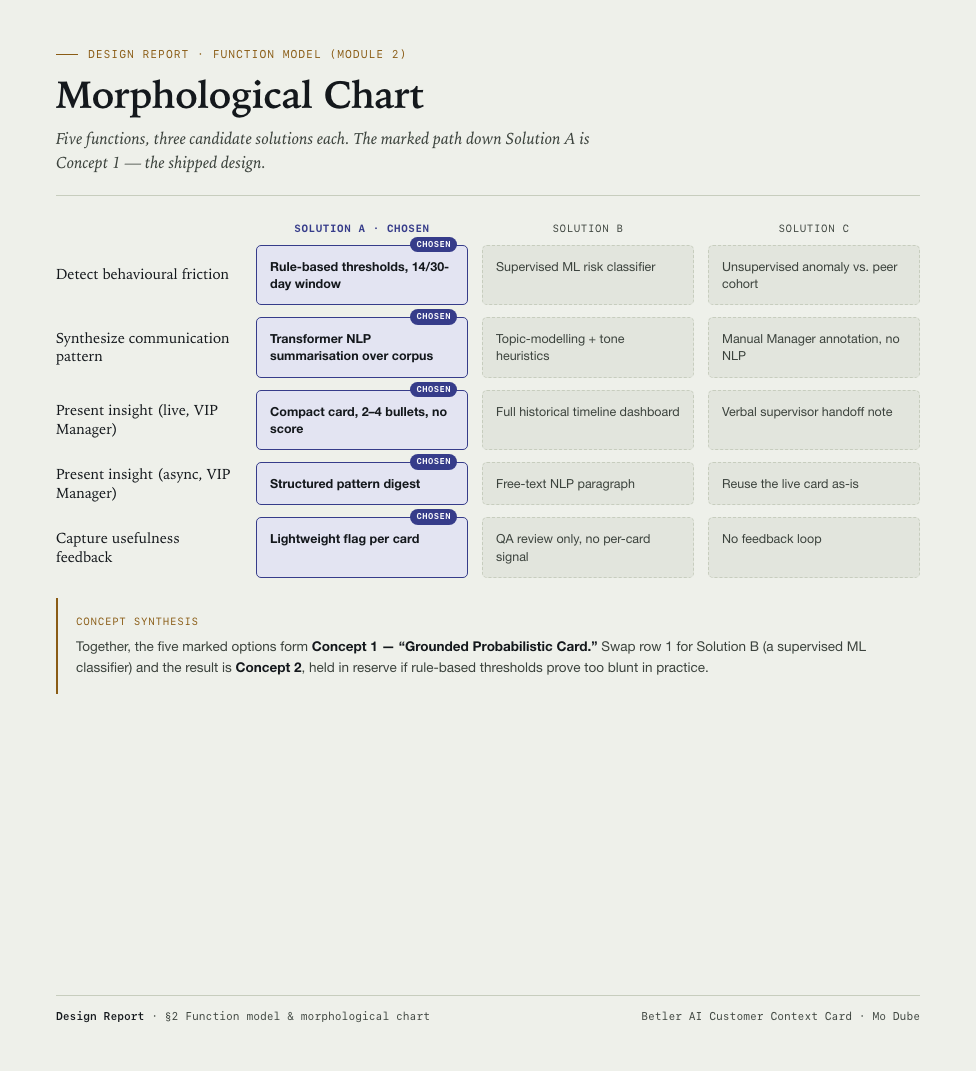
I evaluated multiple design permutations across key functional dimensions to identify the optimal UI patterns for an enterprise assistant:
Key considerations:
Cognitive Focus: Locking the historical pattern panel 10 minutes before through 5 minutes after scheduled calls keeps managers focused entirely on active listening during live conversations.
Data Integrity: Strict enforcement of data currency ensures agents never make decisions based on outdated account states.
Automation Strategy
The Spectrum of Autonomy
To maintain human accountability and user trust, we established a strict boundary around automation:
Zero Deterministic Scoring: The system never assigns a "churn score," "frustration rating," or verdict.
Probabilistic Guidance: All insights use non-deterministic phrasing ("suggests," "may indicate") to ensure agents remain the ultimate decision-makers.
Safety & Compliance Bypasses: The tool explicitly excludes Responsible Gaming decisioning—if an RG threshold is triggered, the system bypasses the Context Card entirely and routes directly to RG specialists.
Designing for Explainability (XAI)
Agents and managers must trust the context provided. Every element in the UI is designed for immediate verification:
Direct Traceability: Clicking any live cue reveals the exact event source, timestamp, and transaction ID.
3-Interaction Threshold: The Past Contact Patterns module requires at least 3 prior recorded interactions before generating a summary. Below this threshold, the UI explicitly states "Not enough data" to prevent premature assumptions.
Feedback & QA Logging: Integrated agent feedback triggers allow staff to log unhelpful cues, feeding directly into model optimization.
UI Breakdown & Component Architecture
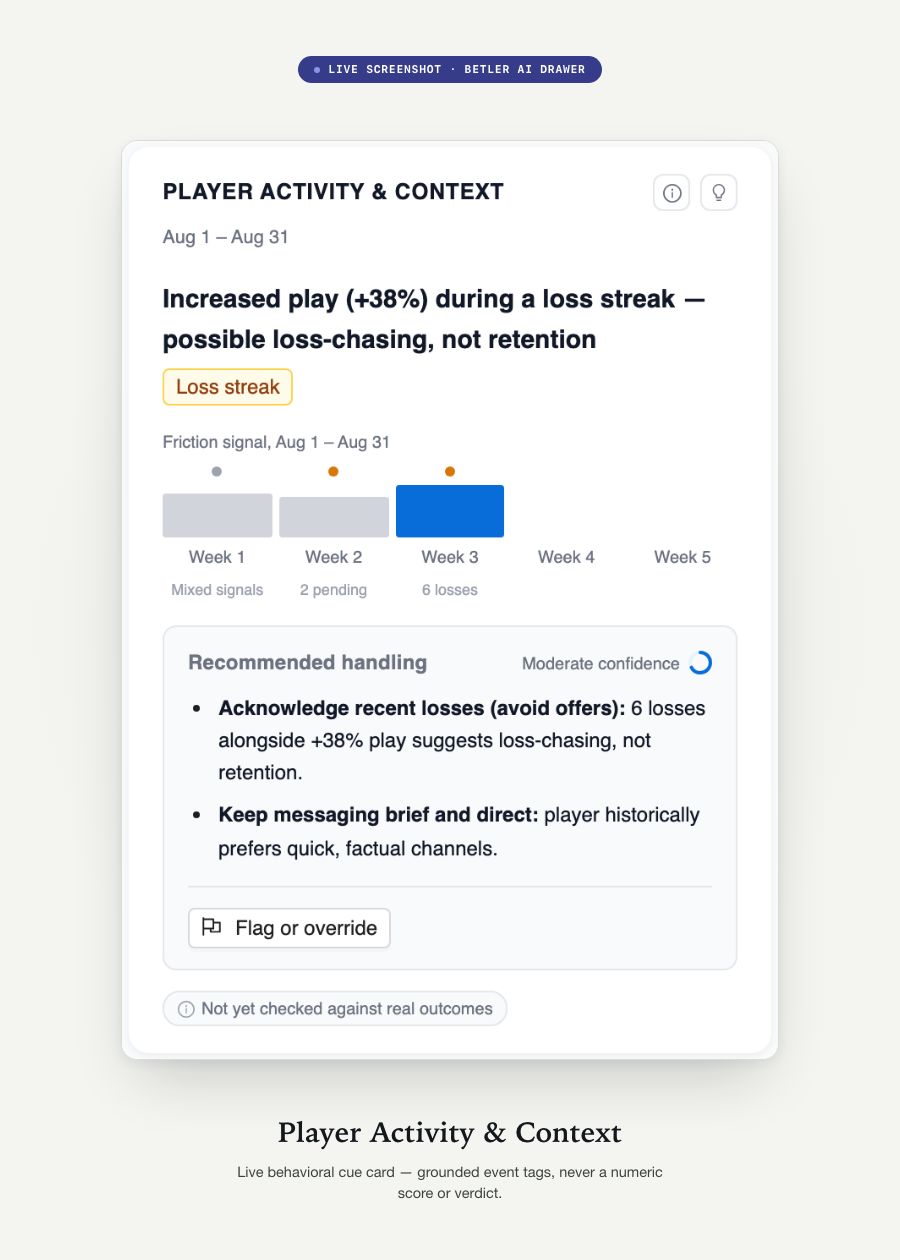
Player Activity & Context
UI Features: Real-time behavioral cue card, live session indicators, and grounded event tags.
What it Contains: A live read of net losses, failed logins, and withdrawal/deposit activity (e.g., "9 sessions without a win" or "withdrawal #123 stuck").
Design & UX Considerations: Displays grounded event cues only never numeric scores, verdicts, or subjective labels.
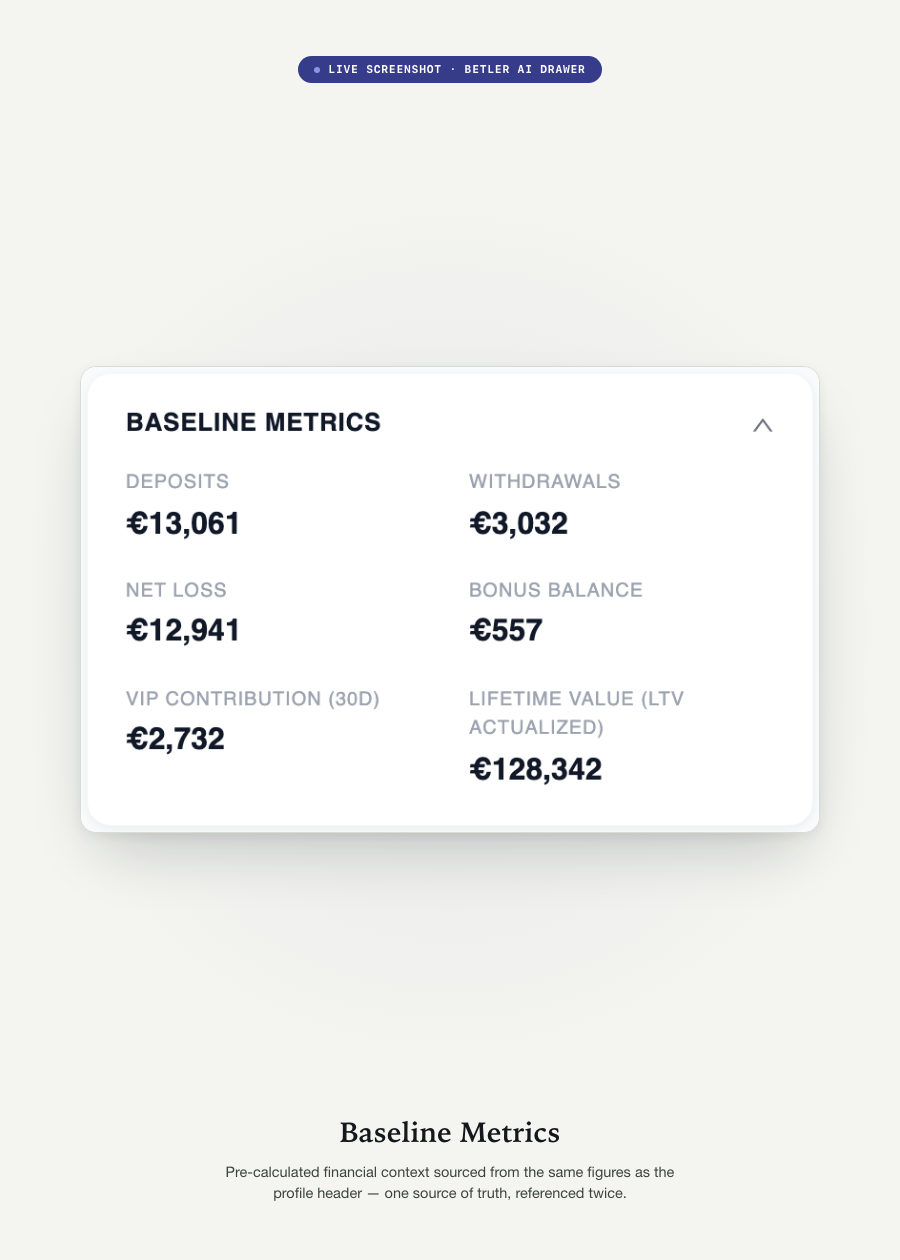
Baseline Metrics
UI Features: High-level metric tracking indicators and operational safety ceilings.
What it Contains: Pre-calculated operational indicators tracking Primary metrics (CSAT top-2-box, First Contact Resolution, Sentiment Delta) alongside Secondary metrics (NPS, Escalation Rate).
Design & UX Considerations: Enforces a strict, pre-set ceiling on Average Handling Time (AHT) where any breach requires a logged exception and sign-off.
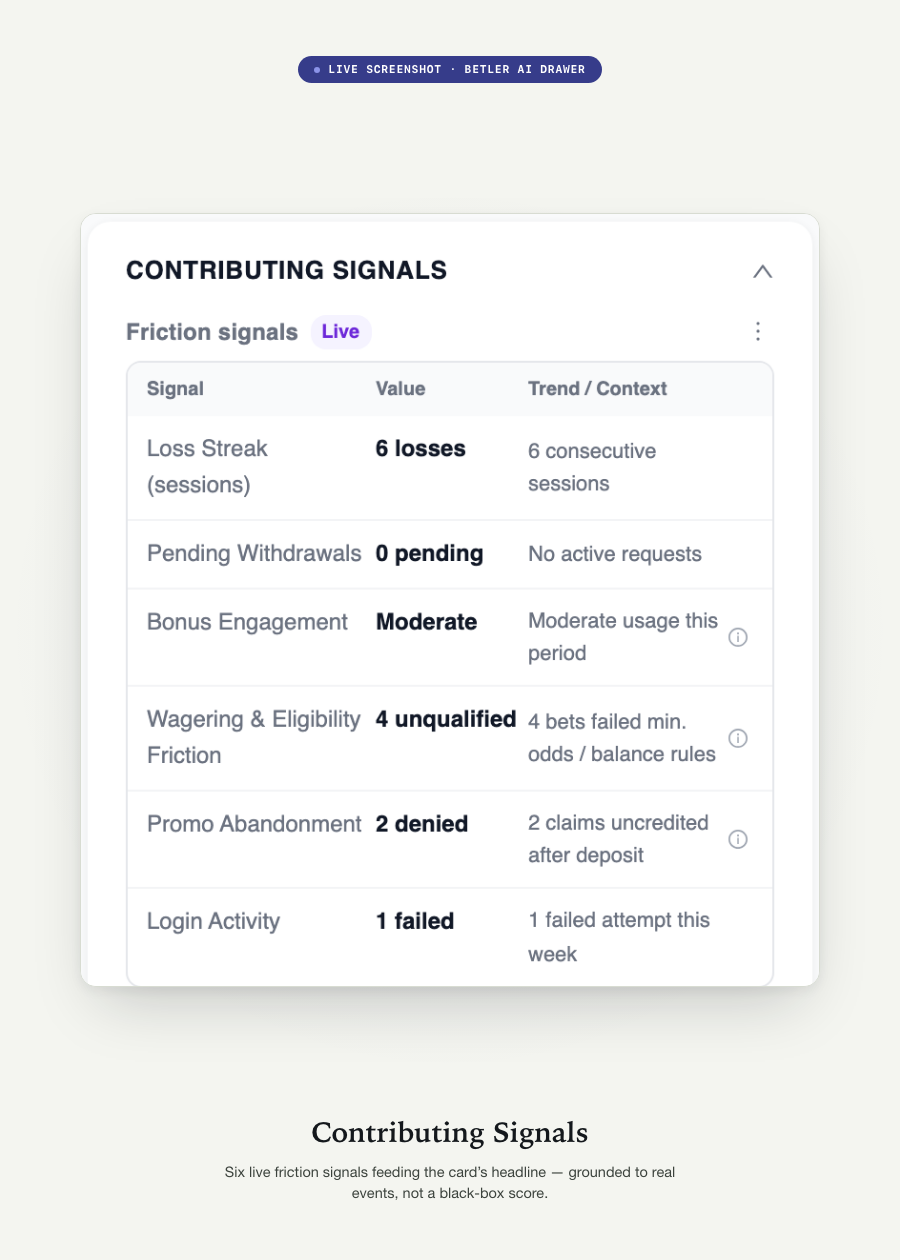
Contributing Signals
UI Features:Asynchronous review panel, AI historical trend summarizer, and transcript/note previews.
What it Contains: Aggregated contact history across transcripts, chat logs, emails, and notes. Requires a minimum threshold of 3 prior interactions before surfacing a pattern; otherwise, it explicitly displays "not enough data".
Design & UX Considerations: Promotes interpretability by linking every historical pattern back to verified, past interaction notes.
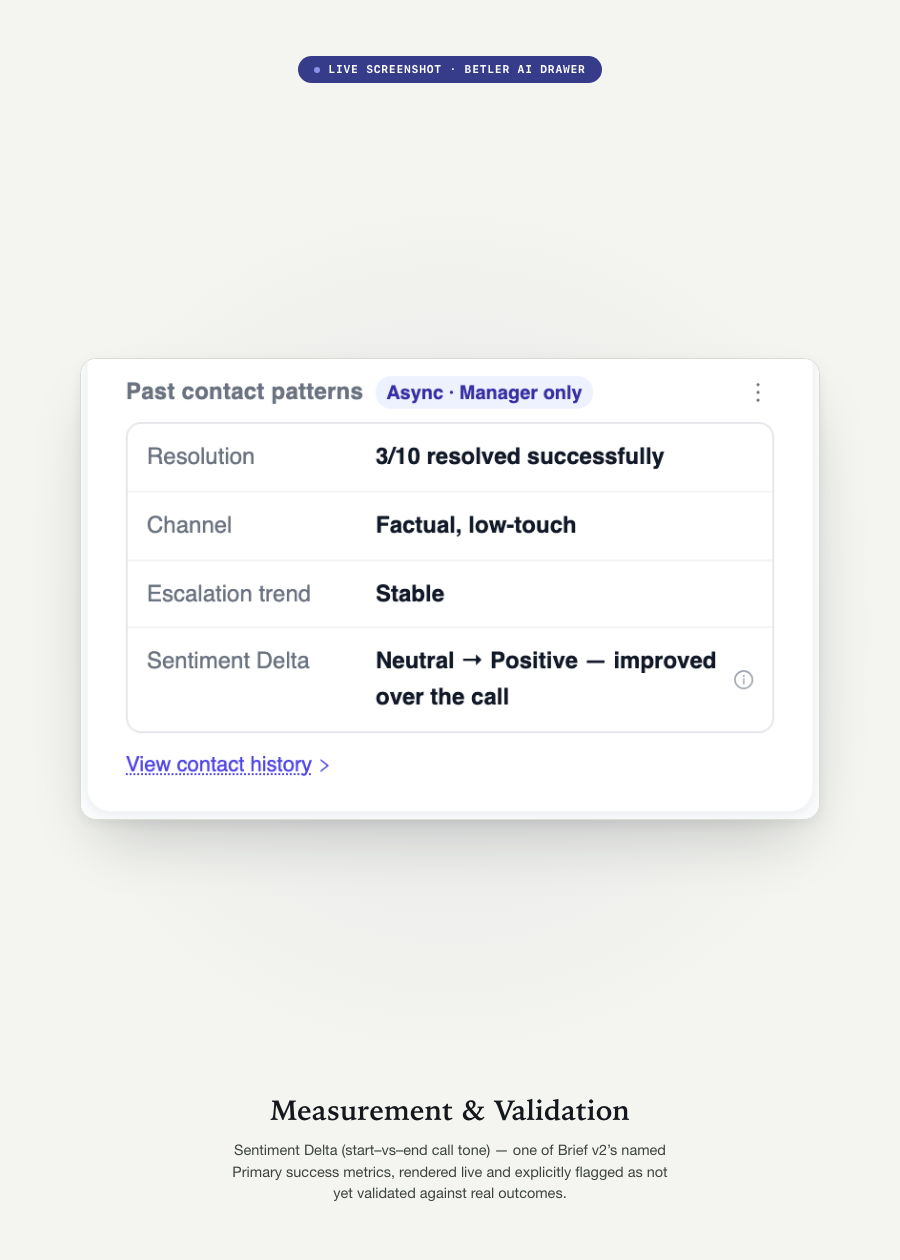
Measurement & Validation
What We Measured (Success Metrics)
Primary Metrics: Top-2-box CSAT score lift, First Contact Resolution (FCR) rate, and Sentiment Delta (start-of-call vs. end-of-call tone).
Secondary Metrics: Net Promoter Score (NPS) and Escalation Rates.
Monitored Guardrail: Average Handling Time (AHT) capped under a strict operational ceiling.
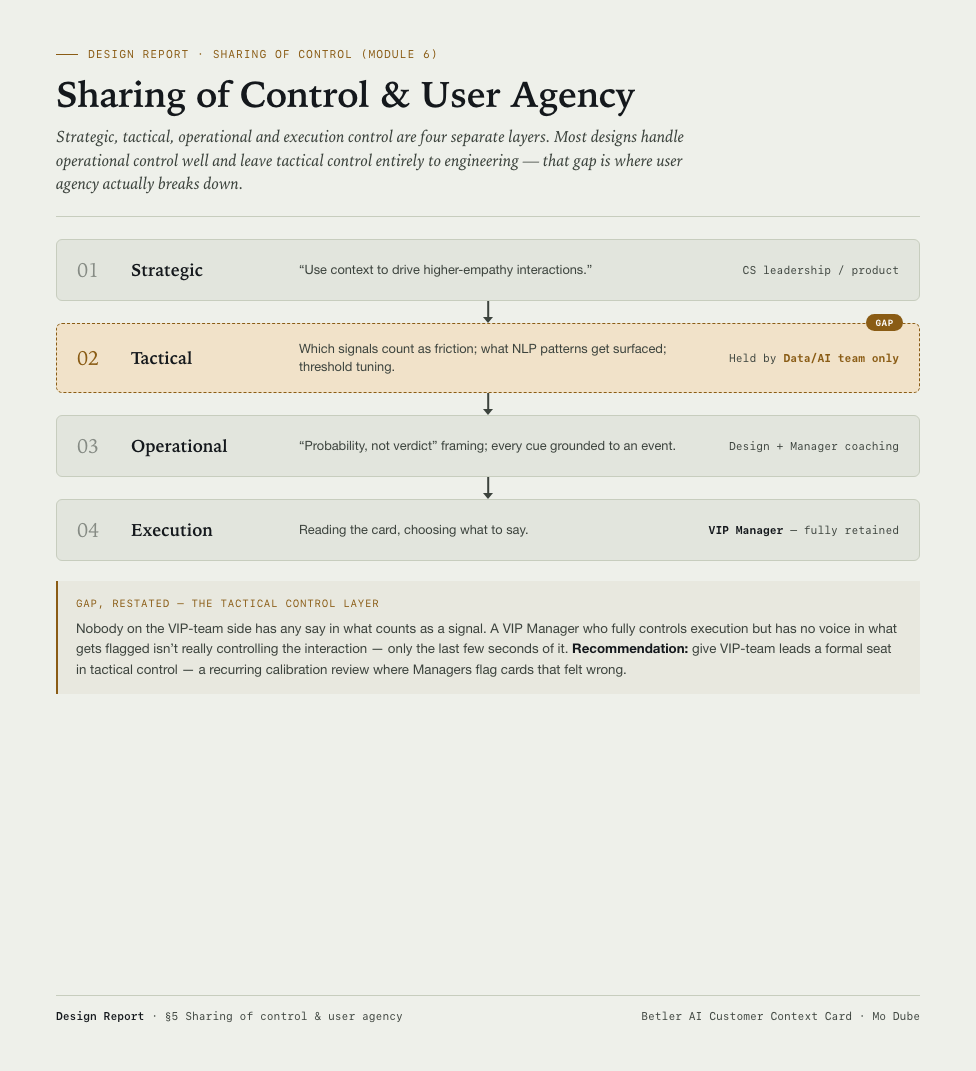
What It Means in Production
Statistically Significant CSAT Lift: VIP Managers using the Context Card achieved higher satisfaction scores within the first 30 days.
Measurable Empathy Improvement: Sentiment Delta tracking confirmed calls ended on a significantly more positive tone compared to control groups.
Efficiency Preserved: CSAT and empathy gains were achieved without breaching AHT safety limits or increasing supervisor escalations.
The platform successfully shifted from a blind, transactional support workflow into an intelligent, AI-assisted system built for rapid resolution and trust.
Outcome
Eliminated support friction for VIP accounts, improved manager empathy metrics, and deployed a scalable, compliant AI behavioral context architecture into production.
Interaction Design
Delivered an accessible, high-contrast side-panel design supporting keyboard navigation, automated view-locking, and clear system status indicators.
Nielsen Norman Alignment
Applied core NN/g heuristics: Visibility of System Status (clear data freshness states), Match Between System and Real World (grounded event traces), Error Prevention (automated in-call panel locking), and Flexibility/Efficiency of Use (scannable pre-call insights).